
The story behind Summit
Built by a cyclist,
for cyclists who train seriously.
Summit didn't start as a startup idea. It started as four subscriptions that never spoke to each other, and one rider doing the joining by hand.
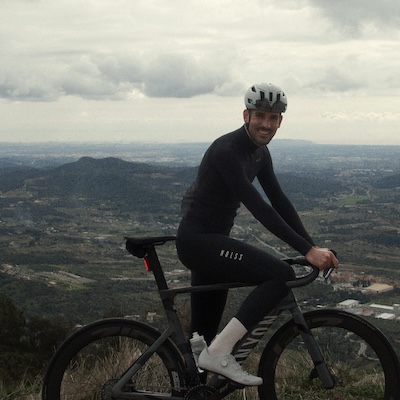
Jordi Espanyol
Founder · Project Summit
I'm an engineer and an amateur cyclist, based in Barcelona. I train consistently and take my performance seriously, with the hours a full-time job leaves me and without the budget of a professional. I live cycling; I don't live off it.
I trained for La Traka 360 — 360 km of gravel in a single day — across four separate apps: one read my recovery, one prescribed the sessions, one held the fitness curve, one handled nutrition. Each was right about its own slice, and not one of them handed anything to the next. I copied numbers between them by hand, paid four subscriptions, and at the end of every week I had data everywhere and clarity nowhere.
The ride went well: I got fit, I rode it, I finished it. What stayed with me was what it had cost — and the realisation underneath it. I had paid four times over, and the part that made the stack work was me, joining the dots every Sunday night.
So I built the joining. I had written some Python at engineering school and nothing since, so I learned what a backend was and what a frontend was — and, in the part I am least proud of and that taught me most, I let code pile up that I did not understand, until the periodisation engine had to be thrown out and written again from zero. That rewrite is the engine Summit runs on today. It is also the platform I prepared my whole Gran Diagonal on, and the one I wish I'd had when I was staring at a TSB chart I couldn't act on.
The problem · The solution
The problem
Too many apps. Too little clarity.
Every app in a stack like that captures part of the picture — the rides, the night, the training load, the fuelling — and each is good at its own part. None of them synthesises the parts into a decision, because none of them can see the others. The athlete is the integration layer, and that integration is unpaid work at the end of an already long week.
You end up knowing what happened. Not what to do.
The solution
One platform. Clear decisions.
Summit does the joining itself: recovery read against your own baselines, training load and power analysis on the sport's own metrics, an adaptive plan, and race-day fuelling — one app, one engine. It doesn't just show you the data; it tells you what to do tomorrow, and every output traces back to a rule you can check.
The plan rewrites itself around your life. Missed a session. Got sick. Travelled. Summit adjusts without you having to think about it.
Design principles
Data to decisions
Every metric in Summit exists to produce a recommendation. If a number doesn't change what you do, it shouldn't be on the screen.
Adapts to real life
Athletes get sick, travel, and miss sessions. The plan that doesn't account for this isn't a plan — it's a wishlist. Summit rewrites around reality.
Serious, not complicated
Professional-grade science shouldn't require a sports science degree to interpret. Summit speaks in training terms, not in jargon.
Stop being the integration layer.
Summit is on the App Store now. Download it, connect Strava, and start riding with a plan that actually knows you.